Why Your Ad Film Needs a Script Before It Needs a Camera
Every business owner who decides to make an ad film starts with the same question: “Which camera will you use?” It’s a natural question, but it’s the wrong one to start with.
The camera captures what already exists on paper. If the idea, message, and structure aren’t clear before the shoot, no camera in the world will fix that. You’ll only spend more money recording confusion in higher resolution.
What an ad film script actually does
A script is not just dialogue. In advertising, it is the blueprint for the entire film. A good ad film script defines:
- The single message. What is the one thing the viewer should remember?
- The audience. Who is watching, and what do they care about?
- The emotional hook. Why will someone stop scrolling or stay on the couch during the break?
- The visual plan. What is seen in every second, and why?
- The call to action. What should the viewer do next?
Without these, a shoot becomes a day of “let’s try this too” and an edit table full of footage that doesn’t add up to a story.
The real cost of skipping the script
Think about where money goes in ad film production: crew, equipment, locations, actors, editing, sound, and music. A script is the cheapest part of the whole process, yet it controls how efficiently every other rupee is spent.
When there’s no script:
- Shoot days stretch. Crews improvise, and every extra hour costs money.
- Reshoots happen. Someone notices a missing shot only during editing.
- The message dilutes. Clients keep adding points until the film tries to say everything and says nothing.
- Editing becomes rescue work. Editors spend time hunting for a story instead of polishing one.
Short films need scripts even more
Many owners assume a 30-second ad doesn’t need a script. It’s the opposite. In 30 seconds you have almost no room for waste. Every second must earn its place. Writing a tight 30-second film is often harder than writing a 3-minute one, because you must remove everything except what matters.
What a good script looks like
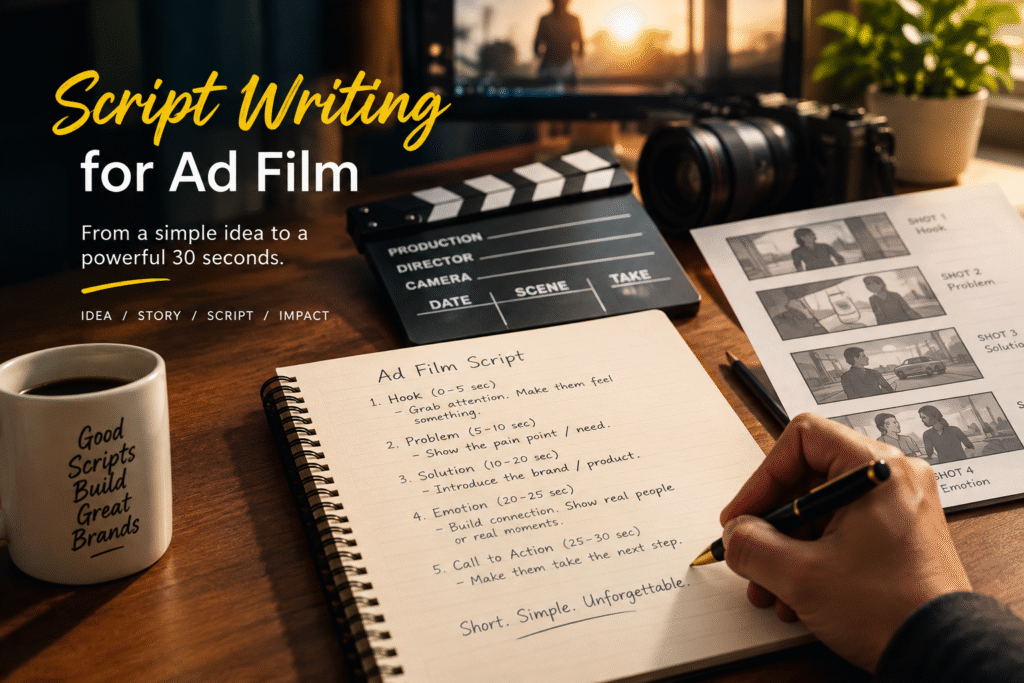
Here is a simple structure that works for most ad films:
- Hook (first 3-5 seconds): A question, a surprising visual, or a relatable problem.
- Problem or desire: Show what your customer struggles with or wants.
- Solution: Introduce your product or service naturally, not forcefully.
- Proof: A result, a testimonial, a demonstration, or a striking visual.
- Call to action: Clear, single, and easy to act on.
For Indian audiences, especially in Maharashtra, language and cultural tone matter too. A line that lands beautifully in Marathi may feel flat when translated word for word into English. A good script is written for the audience, not translated to them.
Script first, budget second
Once the script is ready, budgeting becomes accurate. You know how many locations, how many actors, how many shooting days. There are no surprises, and no “we didn’t plan for this” conversations mid-shoot.
It also lets you compare production houses fairly. When every agency quotes against the same script, you compare like with like.
The takeaway
If you’re planning an ad film for your business, invest your first effort in the idea and the script. Approve the script the way you would approve a building plan: carefully, before construction begins. The camera is a tool. The script is the strategy.
Planning an ad film in Pune? At Chidvilas Studio, every film begins with a script and a strategy conversation, long before the first shot. Talk to us about your idea.